Web
What is AEO and how a website ends up in AI answers
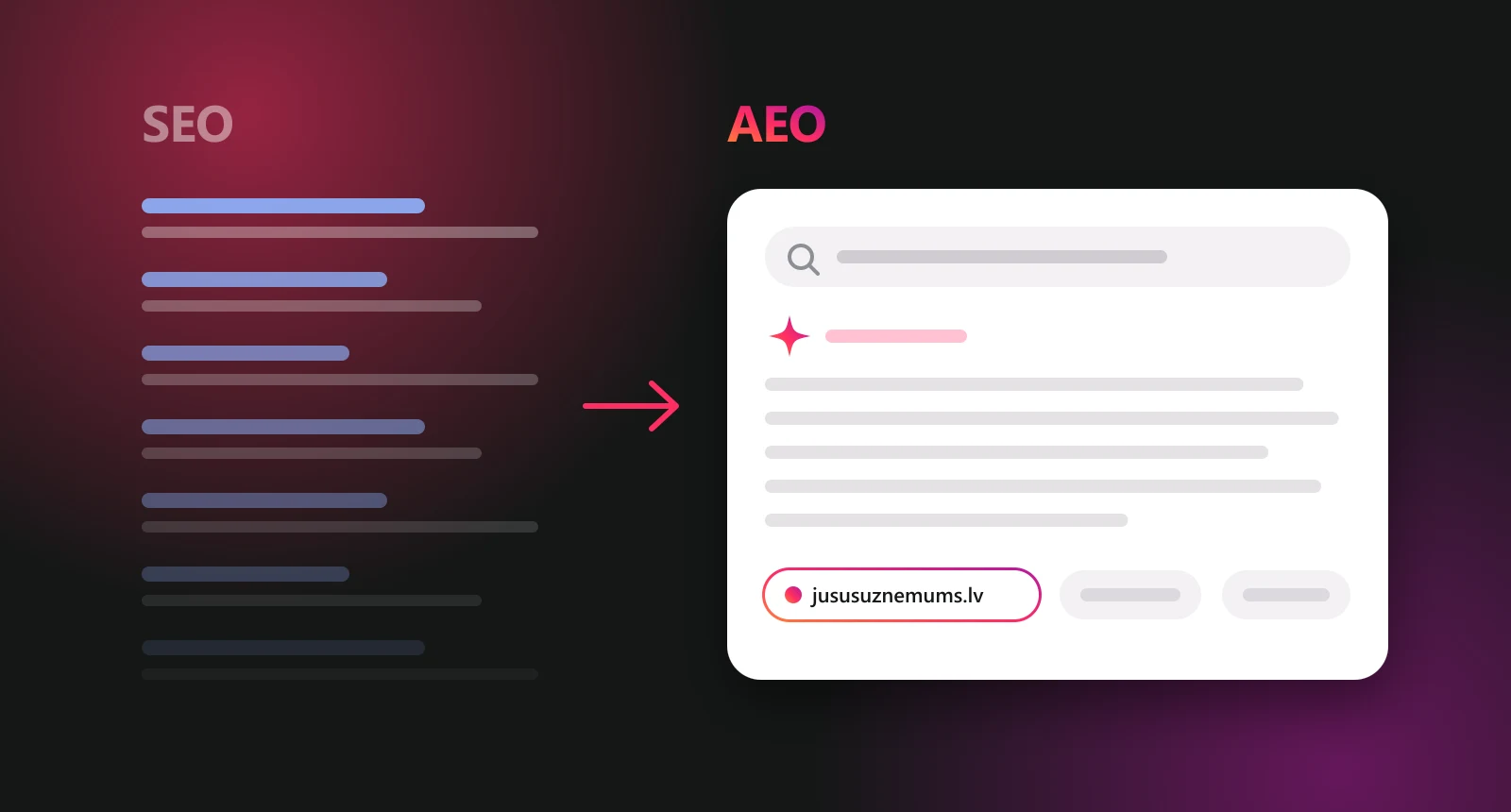
AEO (answer engine optimisation) means preparing a website so that AI tools such as ChatGPT, Perplexity, Microsoft Copilot and Google's AI Overviews can understand your page, use it in an answer and name it as a source. SEO gets you into the list of links. AEO gets you into the answer itself.
Published 7 min readMC Dizains
What is AEO
In classic search, someone types a few words and gets ten links. An answer engine works differently: it reads several pages, combines them into one answer and shows a handful of sources next to it. AEO is all the work that raises the odds that one of those sources is you.
The term isn't new. It was first used around voice assistants and Google's featured snippets, where a short answer appears above the search results. Generative AI has made it far more important, because the answer is now the first thing people read, and often the only thing.
Today these answers come from:
- Google AI Overviews and AI Mode, which write an answer above the normal links.
- ChatGPT, when it searches the web.
- Perplexity, which cites a source for each statement.
- Microsoft Copilot, which runs on Bing search.
- Google Gemini and the voice assistants on your phone or in your car.
How AI decides which page to cite
AI isn't looking for the best website. It's looking for the best answer to one specific question. In simplified form, the process goes like this:
- A crawler such as Googlebot, Bingbot or OAI-SearchBot visits your page and reads its text.
- The page goes into the search engine's index alongside millions of others.
- When someone asks a question, the system picks the passages that answer it most precisely. Often that's one paragraph, not the whole page.
- A language model writes the answer from those passages and adds links to the sources.
Step three is where it's decided. If the answer to "how much does logo design cost" is buried in the fifth paragraph between general statements, it's hard for the system to pull out. On a page that says "Logo design costs €80" right under the heading, it's easy. That's how our own logo design page is written.
Write as if every paragraph will be read on its own, away from the rest of the page. AI often does exactly that.
AEO, SEO and GEO: what's the difference
These terms get mixed up a lot. They aren't competitors; they're layers that build on each other.
| SEO | AEO | |
|---|---|---|
| Goal | A high position in search results | Being a source in an AI answer |
| What people see | A link to your page | An answer that mentions you or cites you as a source |
| How it's measured | Rankings, clicks, visits | Mentions, citations, visits from AI tools |
| What works best | Keywords, links, a technically clean site | Clear answers, verifiable facts, structured data |
GEO (generative engine optimisation) is a newer name for almost the same thing: optimising for answers written by generative AI. In practice AEO and GEO overlap so much that we treat them as one job.
One more important point: AEO doesn't replace SEO. Google itself says AI Overviews need no special optimisation. Good SEO practice and an indexed page are enough. If normal search can't find a page, AI is unlikely to cite it.
What makes a page a good source for an AI answer
These are the things we pay attention to when we build a website:
- A direct answer under each heading. Say the main point in the first 40-60 words and the details after that.
- Concrete facts in the text: prices, timelines, opening hours, the area you serve. AI can only quote what's written down.
- Questions and answers. A FAQ section matches the way people ask AI.
- Structured data (schema.org), a machine-readable description of who the business is, where it is, what it offers and at what price.
- The same details everywhere. Your name, address and phone number should match on the website, your Google Business Profile, Facebook and directories such as 1188.lv.
- Text in the HTML. Many AI crawlers don't run JavaScript, so a site that only loads its content in the browser can look empty to them.
- Permission in robots.txt. If the file blocks OAI-SearchBot or PerplexityBot, for example, those systems can't use your site in their answers.
- A clear author and date. Who wrote it, when it was published and when it was updated. That helps systems judge whether the information is reliable and current.
An honest note on structured data. Since 2023 Google no longer shows expandable FAQ results in search for most sites. The data still helps machines tell a question from its answer, though, so we keep it.
An example: how we do it on this site
It's easier to show than to tell. The site you're reading this on is built on the same principles:
- Every page is generated as finished HTML, so all the text is visible even to a crawler that doesn't run JavaScript.
- robots.txt allows AI search crawlers such as OAI-SearchBot, PerplexityBot and Claude-SearchBot explicitly, one by one, instead of leaving it to chance.
- Structured data describes the business, every service with its price, every article and every question with its answer, all linked together.
- Every service page has a FAQ, and every article opens with a short answer.
- The site root has an llms.txt file: a short summary of the business, its services and prices for language models.
We do the same for client websites. SEO and AEO optimisation is included in the website development price from €800, and the full list of what that price covers is on the pricing page. For an online store the principles are the same; there are just more product pages.
What AEO can't do
To be straight with you: nobody can guarantee that ChatGPT or Google will mention you. Answers change with the wording of the question, where the person is, and even from one try to the next.
- AEO isn't one trick or one file. llms.txt, for example, is a proposal from 2024, not a standard, and Google doesn't use it. This site has one because it costs nothing, but you can't rely on it alone.
- AI still makes mistakes. Clear facts on your site make it less likely to state the wrong price or opening hours, but they don't rule it out.
- Results aren't instant. The page has to be indexed first, and the systems have to start trusting it. That usually takes months, not days.
If anyone promises you "a guaranteed spot in ChatGPT answers", be careful. Why AEO is worth thinking about now rather than in a couple of years is the subject of Why AEO matters right now.
Frequently asked questions
What does AEO stand for?
Answer engine optimisation. It means preparing a website so that AI tools such as ChatGPT, Perplexity and Google's AI Overviews can understand it, use it in answers and cite it as a source.
Does AEO replace SEO?
No, AEO builds on SEO. A site first has to be findable and indexed by search engines; only then can AI use it in an answer.
How do I know if my website appears in AI answers?
Ask ChatGPT, Perplexity and Google the questions your customers would ask and look at the sources. In Google Analytics, some visits from chatgpt.com or perplexity.ai show up in the list of referral sources.
Does a small local business need AEO?
Yes. For local questions such as "where can I get T-shirts printed in Kuldīga", AI usually names only a few businesses, and they're the ones with clear, consistent information online.
Can an existing website be optimised?
Often, yes: the text structure, structured data and technical settings need putting in order. If the content only loads through JavaScript, rebuilding the site can be the better deal. We assess that in a free consultation.
Is AEO included in your website price?
Yes. The website development price from €800 includes SEO and AEO optimisation, plus Google Analytics, Google Business Profile and Search Console setup.
Related services
Services connected to the topic of this article.
Find out how AI sees your website
In a free consultation we look at your current site or planned project and tell you what needs to change.
Read next
Web · 6 min read
Why AEO matters right now
More people now read the AI answer instead of the links. Why that changes what a website is for, and 7 practical steps a small business can take today.
Read article
Web · 6 min read
How much does a website cost: what the price is made of
A website from €800: what the price includes, what costs extra, what a domain and hosting cost per year, and how to prepare so the site is ready in a week.
Read article